Tuesday, January 10, 2017
Monday, October 17, 2016
Fragments of Place
Fragments of Place is a personal
reflection of my temporal existence:
Leaves collected from places which hold
special importance in my life
woven in a tapestry of place.
The main collection of leaves comes from
my husband’s childhood home
a place that has become home to me and
my children
as we have become part of his life, his family.
Leaves from the town where we were
married
where we grew up as college students
where I found employment years later.
These were inserted in to the fabric
woven together with grass from our
current residence.
This place is the only place my children
know as home.
Blades of grass are used to construct
the tapestry
not entirely visible
building its internal structure.
The tapestry of leaves gradates in color
fresh green morphs into red
red fades to black.
It was carefully placed
propped gently against two crossing
vines
draping down to carpet the earth in a
park where I used to play as a child.
Rich, black, soil, excavated from the
site flows around the black leaves anchoring it to the ground.
From this soil leaves which had been
collected and pressed
radiate in a colorful gradation
then fade to black.
The unity
of materials will quickly dry
decay
turn to
dust
in the way
I have left my own dust in each of these places
and traces
of dust from each place has stayed with me.
This journey
began as separation
analysis
of the soil dug from the place of childhood play.
Bits of
decaying leaves, roots, seeds, shells
were
isolated in individual, pristine, housings.
Separated
parts were reunited with their home
photographed
in their new pristine housing
on the
contrasting backdrop of the soil from which it was removed.
Fragments of Place is a personal
reflection of my temporal existence:
Leaves collected from places which hold
special importance in my life
woven in a tapestry of place.
The main collection of leaves comes from
my husband’s childhood home
a place that has become home to me and
my children
as we have become part of his life, his family.
Leaves from the town where we were
married
where we grew up as college students
where I found employment years later.
These were inserted in to the fabric
woven together with grass from our
current residence.
This place is the only place my children
know as home.
Blades of grass are used to construct
the tapestry
not entirely visible
building its internal structure.
The tapestry of leaves gradates in color
fresh green morphs into red
red fades to black.
It was carefully placed
propped gently against two crossing
vines
draping down to carpet the earth in a
park where I used to play as a child.
Rich, black, soil, excavated from the
site flows around the black leaves anchoring it to the ground.
From this soil leaves which had been
collected and pressed
radiate in a colorful gradation
then fade to black.
The unity
of materials will quickly dry
decay
turn to
dust
in the way
I have left my own dust in each of these places
and traces
of dust from each place has stayed with me.
This journey
began as separation
analysis
of the soil dug from the place of childhood play.
Bits of
decaying leaves, roots, seeds, shells
were
isolated in individual, pristine, housings.
Separated
parts were reunited with their home
photographed
in their new pristine housing
on the
contrasting backdrop of the soil from which it was removed.
Tuesday, October 4, 2016
Friday, September 30, 2016
Walk through the park
I took a walk through the park yesterday evening. I chose to navigate an area in the backlog the park where I used to play as a child. I had hoped to gather a large amount of leaves from the ground to work with, but they are still holding strong to the trees. I was able to gather a few fallen leaves in various stages of decomposition. I found many sites with interesting structures formed by dead or dying trees as well as partially fallen trees that have been heaved out of the ground by erosion. The park showed a lot more erosion than I had remembered. Some areas have uncovered evidence of past land development: asphalt, brick, metal. I remember encountering these in small quantities when I was young. There was a mysterious quality about their history, about our history, our making/developing of land and the decomposition of our efforts.
Wednesday, September 28, 2016
Tree Labeling
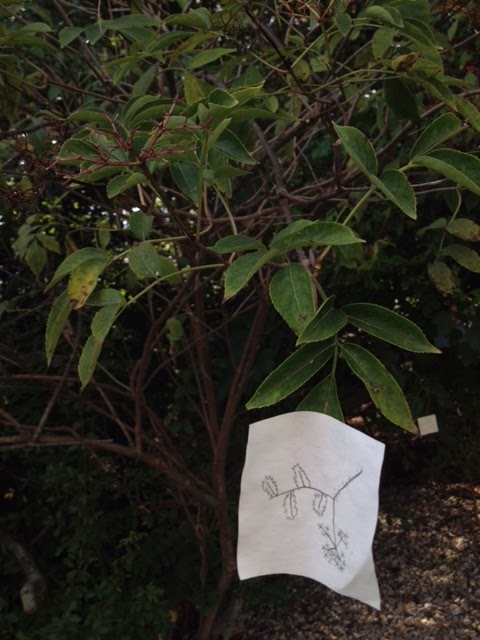
My children are always quite interested in what I am experimenting with. At one point I was explaining that my can of dirt came from a wooded park on Purdue's campus where all the trees are labelled so you know what kind they are. Intrigued by this concept, my older one decided to label our trees. I think she did a fine job...enjoy!
It is certainly nice to have the graphic translation of what I see. Maybe someday we will give them names.
Nature, Art, and Design
I am excited to begin work on a series of new projects this fall. I am finding that I naturally fall into a process of creating site-specific installations. Be sure to click on my Dirt page to see what I am up to now.
Wednesday, December 9, 2015
The Five
Obstructions
From my perspective as
a designer, I see the 5 obstructions mandated by Lars Von Trier for the
recreation of The Perfect Human short
film by Jorgen Leth less as obstructions and more as constraints. After all, the obstructions did little to actually
obstruct the recreated films but, rather, changed their character. The films were accomplished with skill. Each set of rules posed unique challenges which
had to be accounted for during the process of creation. Each constraint posed new perspectives and
new ways of approaching the subject manner.
Design works in this way,
balancing cultural, social, political and physical constraints imposed by the
context of the project. Some constraints
are self-imposed by the values of the designer, some are imposed through the
values of others on the projects. The
constraints are determined by working through context and relationships and
shape the outcome. As Michael Agar said
about ethnography in his book The
Professional Stranger, so it is the same in design – “More than one [design]
is possible but not all [designs] are acceptable. [Designers] are neither completely in charge
nor do they vanish from the process.”
The artist is typically honest in their ownership of control. If an artist relinquishes control to outside
forces it is by choice with explicit intent; they never recede or vanish from the
process (as designers would like to think they do).
This film illustrates, clearly, that more than one
outcome is possible and can be deemed acceptable in its own right. This brings us to the question of criteria
for what is deemed “acceptable” or “good”.
In design we might judge the
outcome based on its attention to constraints and usefulness or function. In art we may judge the outcome based on its insight, expression, or reaction. Can we say that each film created in this
movie was good? Do we base our
acceptance in reference to the constraints? This movie is about the process. It, however, was not just about reacting to
constraints, but it became clear that art was created through the process as healing. Is the process, or the purpose for the act of
creating, that which we base our judgments?
One
thing remains constant; our judgment is embodied, experiential, and culturally
based. Criteria changes and will
continue to evolve; it is contextual and situated in the past, present, and future.
Friday, October 9, 2015
Huang Yi & Kuka
It is said that science deals with that-which-is, technology with that-which-can-be, and the humanities with questions about that-which-should-be. I left the pre-show discussion with a really uneasy feeling about the topics presented. From videos of dog-like robots to human replica robotics, the discussion was very technology focused with barely a hint to the question of what should be created (rather than what can be created). The Huang Yi & Kuka performance, however, was beautifully and artfully accomplished. We were taken on a journey which invoked human expression of empathy with the machine through movements and interaction, the machine's "perspective" through seeing, and culminating in a performance that was orchestrated to appear as if the machine were controlling the digital movements of the human dancers all-the-while remaining purposefully aware of the machines existence as a machine. There was no attempt to mask its true being, trick your senses, or be perceived as anything other than what it is. That is to say it was not made to represent anything other than the machine. Its form, sound, and functional abilities were celebrated through each act of the performance.
Friday, August 28, 2015
Potential Space in the Building
Second Floor Option?
There is a hallway space on the second floor of PAO at the top of the stairs with windows where some old furniture used to be located. Students used that furniture/space quite a bit. I noticed that the furniture is gone. Is it going to be replaced? If so or if not, could we (I) potentially use that space for an installation?
Thursday, August 27, 2015
Options for Three Artists
Installation Design related to Interiors:This is my final choice:
dgtarchitects exhibition work http://www.dgtarchitects.com/project/program/exhibition/en
Other options (not selected)
Numon / For Use (Tape Paris) http://www.numen.eu/installations/tape/paris/
Options from the list:
Random International
Andrea Zittel
Soo Sunny Park
Subscribe to:
Posts (Atom)